
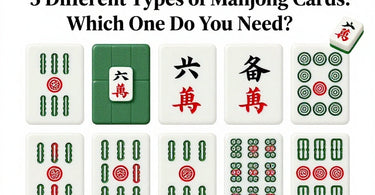
If you are shopping for mahjong cards, the first thing to understand is that not every card serves the same purpose. Some cards define the hands players are allowed to make, some summarize a regional rule set, and others are teaching or scorekeeping aids. Buying the wrong one can leave a perfectly good mahjong set sitting unused because it does not match the game your group actually plays.
From our experience with mahjong products and the questions players ask when choosing a set, the most important distinction is between an official hand card and a general reference card. American Mahjong players usually need the current National Mah Jongg League (NMJL) card. Players of Chinese, Japanese, or other regional styles generally do not use that annual card at all.

This guide explains five practical types of mahjong cards, what each one does, who should use it, and what to check before buying. We will also explain how cards work with a physical tile set, because the card and the tiles need to match the same version of the game.
Quick Answer: What Are the 5 Different Types of Mahjong Cards?
The five useful categories are: the annual American Mahjong hand card, a regional or rules reference card, a beginner teaching card, a scoring and scorekeeping card, and a tournament or event reference card. They are not interchangeable. For regular American Mahjong, start with the current NMJL card; for other styles, choose a reference designed for that specific rule set.
- What they are: Printed guides that show permitted hands, rules, scoring information, or learning prompts.
- How they work: Players consult the card during play to identify legal combinations, confirm rules, or record scores.
- Main benefit: They reduce uncertainty and help a group play consistently.
- Main limitation: A card written for one mahjong variation may not apply to another.
- Best for: American Mahjong groups, new players, teachers, clubs, and organized events.
- Not necessary for: Experienced players of some traditional styles who already know the rules and use a different scoring method.
Quick Summary Table: 5 Types of Mahjong Cards
| Card type | Main purpose | Best for | Buying advice |
|---|---|---|---|
| 1. Annual American Mahjong hand card | Lists the valid hands for a particular card year | American Mahjong players | Check the year and official source before buying |
| 2. Regional rules reference card | Summarizes a specific regional ruleset | Players learning or switching styles | Confirm the exact variation it covers |
| 3. Beginner teaching card | Explains tile suits, combinations, and basic play | First-time players and instructors | Choose clear diagrams and readable print |
| 4. Scoring and scorekeeping card | Helps calculate, track, or record scores | Casual groups and game hosts | Make sure its scoring method matches your rules |
| 5. Tournament or event reference card | Provides quick rules, procedures, or event-specific information | Clubs, tournaments, and organized play | Use the organizer's current approved version |
What Are Mahjong Cards?
Mahjong cards are printed or digital aids used to explain, organize, or support a mahjong game. The phrase can refer to several different things, which is why buyers should identify the intended use before placing an order.
In American Mahjong, the word "card" most often means the annual hand card. It lists combinations that players can build with their tiles, along with the number of tiles and the associated point values or other hand information. Players use it throughout the game to select a hand and check whether their tiles fit a listed pattern.
In other contexts, a mahjong card may be a compact rule sheet, a beginner's visual guide, a score sheet, or an event-specific reference. These are helpful accessories, but they do not replace the actual tiles. A mahjong tile set contains the physical pieces used to play; a card explains what to do with those pieces.
How do mahjong cards work?
First, the group agrees on the variation it will play. Players then use the matching card or reference to understand legal combinations, calls, scoring, and other procedures. In American Mahjong, for example, the hand card is central to deciding which patterns are valid for that card year. In a teaching session, a beginner card may instead help a learner identify dots, bams, cracks, winds, dragons, flowers, and jokers.
1. Annual American Mahjong Hand Cards
For American Mahjong, the annual hand card is the most important card type. The National Mah Jongg League publishes a new card each year with the hands that players may use during that card year. Players study the listed patterns, choose a target hand, and arrange their tiles to match it.
The annual update is not a cosmetic refresh. The available hands and their patterns can change from year to year, so a card from a previous year may not be suitable for a group playing under the current NMJL card. This is the main reason American Mahjong players should pay attention to the edition date.
How the annual card is used
- Players review the listed hands and select one they want to pursue.
- They organize their tiles around the required suits, numbers, honors, and other elements.
- As the game develops, they adjust their strategy based on the tiles they draw and discard.
- They refer to the card to confirm whether a hand is valid and how it is classified.
For a beginner, the card can look dense at first. Symbols, abbreviations, and compact hand descriptions take time to understand. That is normal. It becomes easier when a player learns the tile families and practices reading one line at a time rather than trying to memorize the whole card.
Who should buy this type?
Choose an annual American Mahjong hand card if your group plays American Mahjong according to the NMJL system. It is especially important for regular players, instructors, clubs, and anyone joining a group that expects the current annual card.
If you are still learning the basic game, pair the card with a beginner-friendly explanation of the rules. Our American Mahjong guide for beginners is a useful starting point before trying to read every hand on the card.
2. Regional Mahjong Rules Reference Cards
Mahjong has developed into multiple regional styles. The rules, scoring systems, tile requirements, and winning-hand structures can differ substantially. A regional rules reference card is designed to help players follow one of those systems.
Depending on the product, it may summarize the tile set, winning conditions, calls, scoring patterns, or special rules. Some are printed as compact reference sheets; others are included in learning materials or supplied by a club. The key is that the information must match the version your group actually plays.
Examples of regional rule differences
Chinese Classical, Hong Kong-style, Japanese Riichi, and American Mahjong are not simply different names for the same game. They can use different scoring approaches and hand requirements. Japanese Riichi, for instance, has its own terminology and procedures, while American Mahjong uses a hand card and includes features such as jokers and specific calling rules.
If you are comparing styles before choosing a set, read our overview of different types of mahjong games. It is a better first step than buying accessories based on a regional label you have not checked.
Who should use a regional reference card?
It is useful for players who are learning a new regional style, groups with occasional rule disagreements, and hosts who want everyone to follow the same procedures. It can also be helpful when a player moves between groups that use different rule sets.
For experienced players who know their variation thoroughly, a reference card may be unnecessary during normal play. However, keeping one available can still be useful when teaching newcomers or settling an unusual rules question.
3. Beginner Mahjong Teaching Cards
A beginner teaching card is designed to make the game easier to understand. It may show the tile suits, explain common combinations, define terms, or walk a learner through the sequence of a turn. Unlike an annual American Mahjong hand card, its primary purpose is instruction rather than listing the complete set of playable hands for a specific year.
For beginners, this is often the most useful supplementary card. A new player can be overwhelmed by the number of tiles, unfamiliar terminology, and decisions happening around the table. A well-designed visual guide reduces that learning curve.
What should a good beginner card include?
- Clear images of the main tile families and honor tiles.
- Simple explanations of pairs, pungs, kongs, and other relevant combinations.
- A short outline of the turn sequence.
- Definitions of common calls and gameplay terms.
- Readable type and diagrams that remain clear at normal table distance.
- Rules that match the specific mahjong variation being taught.
We recommend choosing a card that teaches the game in stages. A reference crammed with every exception may be technically comprehensive but not particularly useful to a first-time player. Start with tile recognition and basic turn structure, then introduce scoring and strategy after the player understands the flow of the game.
Is a beginner card worth buying?
For a household introducing mahjong to friends or family, yes, provided the card is accurate and variation-specific. It can save the host from repeating the same explanations every few minutes. For a group of experienced players, however, a teaching card is usually an optional extra rather than an essential purchase.
4. Mahjong Scoring and Scorekeeping Cards
Scoring and scorekeeping cards help players calculate points or record the results of a game. They are particularly useful when the scoring method involves several conditions, bonuses, or hand values that players may not remember immediately.
Some cards explain scoring combinations and point values. Others provide blank spaces for recording player names, rounds, payments, or running totals. A score sheet is not necessarily a rules card: it records the result, while a scoring reference explains how the result should be calculated.
What to look for in a scoring card
- Correct scoring system: the card must match the regional variation and house rules.
- Easy-to-read layout: point values and categories should be easy to locate during play.
- Enough recording space: a score sheet should accommodate the number of players and rounds.
- Clear terminology: avoid cards that use unexplained abbreviations.
For casual groups, a simple score sheet may be all that is needed. For a club or regular game night, a reusable score pad or clearly organized scorekeeping card can make sessions run more smoothly.
5. Tournament and Event Reference Cards
Tournament and event reference cards are prepared for organized play. Depending on the event, they may summarize approved rules, table procedures, timing, penalties, scoring instructions, or other information participants need to follow consistently.
These cards are different from general learning aids because they are tied to an organizer's requirements. A local club may create a one-page reference for its own event, while a formal competition may direct players to a specific rulebook or official document. The organizer's current instructions take priority over a generic card purchased online.
When are event cards useful?
- When a club hosts a beginner workshop or introductory session.
- When a tournament needs players to follow the same event procedures.
- When a group uses a published set of house rules.
- When a host wants quick reminders available at each table.
Do not assume that an event reference card is an official governing document. Check who issued it, which event or ruleset it applies to, and whether it has been updated. For formal play, use the organizer's approved materials rather than an unofficial summary.
Comparison Table: Which Mahjong Card Should You Choose?
The right choice depends on what you need the card to do. This comparison is a practical buying guide, not a claim that every group needs all five types.
| Card type | Primary job | Essential or optional? | Best buyer | What to verify |
|---|---|---|---|---|
| Annual American Mahjong hand card | Shows valid hands for the card year | Essential for NMJL-style American Mahjong | American Mahjong player | Current year and authentic edition |
| Regional rules reference | Summarizes one variation's rules | Optional, but useful for learning | New or transitioning player | Exact regional style and rule version |
| Beginner teaching card | Explains tiles and basic gameplay | Optional learning aid | New player, teacher, or host | Accuracy, diagrams, readability |
| Scoring and scorekeeping card | Explains or records scores | Depends on group needs | Regular group or game host | Scoring system and enough writing space |
| Tournament or event reference | Summarizes event procedures | Required only when specified | Club or event participant | Organizer approval and current instructions |
Our recommendation by player type
- First-time player: begin with a teaching card and a beginner guide. If you are learning American Mahjong, also get the current annual hand card used by your group.
- Regular American Mahjong player: prioritize the current NMJL card. Add a teaching or scorekeeping aid only if it solves a real problem.
- Chinese or Japanese mahjong player: choose a reference written for your exact regional style. Do not buy an American hand card unless you also play American Mahjong.
- Club or event organizer: prepare consistent reference materials and make sure every table is using the same approved rules.
Pros and Cons of Using Mahjong Cards
Mahjong cards are useful tools, but they do not automatically make a game easier. Their value depends on whether the information is accurate, readable, and relevant to the variation being played.
| Pros | Cons |
|---|---|
| Help players check hands, rules, or scoring without relying entirely on memory. | A card for the wrong variation can create confusion rather than solve it. |
| Make it easier to teach new players and keep a group on the same page. | Dense layouts and unexplained abbreviations can overwhelm beginners. |
| Support consistent play in clubs, classes, and organized events. | Some cards become outdated when annual hands or event rules change. |
| Can reduce interruptions caused by repeated rules questions. | They do not replace learning the flow and strategy of the game. |
| Compact and easy to keep with a mahjong set. | Small print, poor paper, or low-contrast diagrams may be difficult to use at the table. |
Our view: the right card is worth having when it supports the game your group actually plays. Buying several generic cards "just in case" is rarely a good use of money. Start with the one essential reference for your variation and add accessories only when you know what is missing.
What to Check Before Buying Mahjong Cards
Product photos can make two cards look similar even when their content is completely different. Before purchasing, check the details below. These points matter whether you are buying a single card for home play or ordering supplies for a class or club.
1. Confirm the mahjong variation
Look for a clear statement identifying American Mahjong, Japanese Riichi, Chinese Classical, Hong Kong-style, or another named ruleset. If the listing only says "mahjong card," ask the seller for clarification.
2. Check the edition or publication year
This is particularly important for annual American Mahjong hand cards. If the card is tied to a particular year, make sure it is the edition your group uses. Avoid assuming that an older card is interchangeable with a current one.
3. Inspect readability
Small print may be acceptable for a compact reference, but it should remain legible under normal indoor lighting. Check the contrast, symbol clarity, spacing, and whether abbreviations are explained.
4. Understand what is included
Some products are standalone cards; others are part of a complete mahjong set or learning kit. Check whether the package includes tiles, racks, pushers, dice, a wind indicator, or other accessories. Do not assume these are included just because they appear in a lifestyle photograph.
5. Check the rules and content source
For official or annual material, identify the issuing organization. For teaching and scoring aids, check the author, publisher, or club that prepared the content. A neat design is not proof that the information is correct.
6. Consider durability and portability
If the card will be used frequently, a sturdy finish and practical size matter. A card that stays flat and can be read without constant handling is more useful than a delicate decorative print.
7. Match the card to your tile set
For American Mahjong, check that your tile set contains the tile types and quantities needed for the rules you play, including jokers where applicable. If you are still choosing physical tiles, our guide to places to buy mahjong tiles explains what to consider when comparing options.
Common Mistakes When Choosing Mahjong Cards
Buying an American Mahjong card for a different style
This is the biggest mismatch. American Mahjong's annual hand card is not a general guide to every mahjong variation. Identify the ruleset first.
Using an outdated annual card
If your group follows the current NMJL card, an older edition can send you toward hands that are no longer part of the current card. Confirm the year before you buy or join a game.
Confusing a teaching card with a gameplay card
A beginner chart may explain tile names and basic combinations without listing the hands needed for a particular game. It is helpful for learning, but it may not be enough to play under a specific ruleset.
Assuming every scoring aid is universal
Scoring systems vary. A score sheet or point chart should be checked against the group's rules, not selected because it looks comprehensive.
Buying a complete tile set without checking its accessories
Some sets include a reference card, while others do not. Check the product description and included-items list so you know whether you need to purchase learning or scoring materials separately.
Choosing a Mahjong Card and Tile Set Together
A card is only one part of a playable setup. The physical tile set must also suit the variation, the number of players, and the way your group likes to play. For American Mahjong, for example, players commonly look for a set with clearly distinguishable suits, winds, dragons, flowers, and jokers. Readability matters because players need to identify tiles quickly across the table.
For a new household group, we recommend choosing the game style before buying the set. Then check tile count, tile size, engraving or printing clarity, racks, pushers, dice, and storage. If you want to compare complete sets, our roundup of mahjong sets to consider in 2026 can help you evaluate the practical differences.
Players interested in Chinese-style sets may also want to compare Chinese mahjong sets with numbers and traditional Chinese mahjong sets. Numbered tiles can be helpful for some learners, but the right choice still depends on the ruleset and the preferences of the group.
Do not overlook the playing experience
Tile weight, feel, sound, engraving contrast, and storage all influence how enjoyable a set is to use. If your group plays regularly, a well-organized case and accessories that keep everything together can be worth paying more for. If you play only occasionally, prioritize clear tiles and the correct contents rather than premium extras.
Story-suns: An American Mahjong Set for Play and Display

Heritage Burgundy American Mahjong Set with Black Tiles and Display Case
$159.90
For players who have chosen American Mahjong and want a coordinated tile set, the Story-suns Heritage Burgundy set combines distinctive black tiles with a structured burgundy vegan leather display case. It is designed for regular game nights as well as storage and gifting.
The set's black tiles feature colorful engraved dots, bams, craks, flowers, dragons, winds, and jokers, with corner indices intended to make tile recognition easier. That visual clarity is a practical advantage during play, especially when several players are still becoming familiar with the tile faces.
The two-piece burgundy case has a lift-off lid and fitted cream interior, while scoring chips, dice, and a wind indicator keep key accessories together. It is a considered choice for a home game setup where presentation matters as much as organization.
Who is this set best suited to?
- American Mahjong players who want a distinctive black-tile set.
- Hosts who keep their set visible between game nights.
- Buyers looking for a housewarming, holiday, or hostess gift.
- Players who value coordinated storage for tiles and accessories.
One important buying point: the set is a physical tile and accessory product, not a substitute for the current annual American Mahjong hand card. If your group follows the NMJL card, make sure you have the correct card separately. That combination gives you the tiles and the current hand reference needed for your game.
How to Get More Confident at the Mahjong Table
A reference card can help you make decisions, but familiarity with the game comes from practice. Once you understand the tile families and the rules of your variation, you can focus more on reading the table and less on searching for basic definitions.
For American Mahjong players, the next step after learning the card is understanding how to choose a hand and adapt as tiles are discarded. Our guide to mahjong strategy tips covers practical ways to read the table and make more consistent decisions.
It is also useful to understand the time commitment before arranging a regular game night. See our guide to how long a full game of mahjong takes when planning a session with friends or family.
Frequently Asked Questions About Different Types of Mahjong Cards
1. What are the different types of mahjong cards?
The five practical categories are annual American Mahjong hand cards, regional rules reference cards, beginner teaching cards, scoring and scorekeeping cards, and tournament or event reference cards. Each serves a different purpose, so choose one that matches your game variation and experience level.
2. What card do you need for American Mahjong?
Players following the National Mah Jongg League system generally use the current annual NMJL hand card. It lists the hands available for that card year. Confirm the edition your group follows before purchasing, especially if you are joining an established game.
3. Do all mahjong games use the same card?
No. Mahjong has several regional variations with different rules, hand structures, and scoring methods. An American Mahjong hand card is not a universal guide for Chinese Classical, Hong Kong-style, Japanese Riichi, or other variations.
4. How often does the American Mahjong card change?
The NMJL publishes an annual card for its American Mahjong system. Players should check that they have the card for the year their group is playing rather than relying on an old edition.
5. Are beginner mahjong cards worth buying?
They can be worthwhile for new players, teachers, and hosts. A good beginner card explains tile families, combinations, and basic gameplay in a clear visual format. Experienced players who already know the rules may not need one.
6. Is a mahjong score card the same as a hand card?
No. A hand card lists permitted combinations or hands, while a scorekeeping card records results. A scoring reference may explain point values, but it should not be confused with a hand card or a blank score sheet.
7. Can I use a mahjong reference card with any tile set?
Not necessarily. The card must match the variation being played, and the tile set must contain the pieces required by that variation. Check the tile count, special tiles, and accessories before buying a set and card separately.
8. Should beginners buy a complete mahjong set or cards first?
First decide which variation you want to learn. Then choose a compatible tile set and the correct learning or gameplay reference. For American Mahjong, that usually means a suitable tile set plus the current annual hand card and a beginner guide if needed.
9. What should I check before buying a mahjong card online?
Check the variation, edition year if applicable, issuing organization, readability, included content, and whether it is a hand card, teaching aid, scoring aid, or event reference. Do not rely on a generic product title alone.
10. Does the Story-suns Heritage Burgundy set include the annual American Mahjong card?
The product information describes the tiles, display case, scoring chips, dice, and wind indicator. It does not identify the annual NMJL hand card as an included item. If you play with the NMJL system, confirm the card requirement separately before your first game.
References and Further Reading
For rules-sensitive purchases, use sources that identify the relevant game variation and issuing organization. These references are useful starting points for understanding American Mahjong and the differences between rule systems.
- National Mah Jongg League. Official NMJL website — information about the organization and its American Mah Jongg materials.
- World Mahjong Organization. World Mahjong Organization — background on organized mahjong and international competition.
- Mahjong Museum. Mahjong Museum — historical and cultural background on mahjong and its development.
Final Recommendation: Buy the Card That Matches Your Game
The phrase "different types of mahjong cards" covers several products, but most players do not need all of them. If you play American Mahjong, prioritize the current annual hand card. If you are learning, add a clear teaching aid. If your group needs help with points or event procedures, choose a scoring or event reference written for the exact rules you follow.
For beginners, we recommend keeping the setup simple: learn one variation, use a compatible tile set, and keep the relevant reference close at hand. For regular players, accuracy and edition year matter more than decorative packaging. For hosts and clubs, consistency is the priority—everyone at the table should be working from the same rules.
And when choosing a physical set, look beyond appearance. Clear tile faces, practical accessories, and organized storage make a real difference over repeated games. The Story-suns Heritage Burgundy American Mahjong Set is an option for players who want a distinctive black-tile set with a polished display case, while the correct annual hand card remains a separate consideration for NMJL-style play.
Explore the Story-suns Heritage Burgundy American Mahjong Set and choose your card according to the version of mahjong you intend to play.
