

Backgammon is one of the oldest known board games in human history, with roots tracing back nearly 5,000 years to ancient Mesopotamia. Despite its age, it remains a vibrant, exciting, and deeply strategic game played by millions worldwide. Whether you are looking to pass the time with friends or engage in competitive tournaments, learning the art of playing backgammon for beginners is a rewarding journey that combines luck, probability, and tactical skill.

The beauty of backgammon lies in its balance. A novice can defeat a master in a single game if the dice roll in their favor, but over a series of games, skill will always prevail. This guide is designed to take you from a complete novice to a confident player. We will cover the setup, the movement rules, the unique concept of the doubling cube, and the essential strategies needed when playing backgammon for beginners.
- 1. Understanding the Board and Setup
- 2. The Objective of the Game
- 3. Movement Rules and Mechanics
- 4. Hitting Blots and Entering from the Bar
- 5. Bearing Off: The Endgame
- 6. The Doubling Cube Explained
- 7. Essential Strategies for Beginners
- 8. Elevating Your Experience: Equipment Matters
- 9. Summary of Key Terms
- 10. Frequently Asked Questions (FAQs)
- 11. References
1. Understanding the Board and Setup
Before rolling the dice, you must understand the geography of the battlefield. The backgammon board typically consists of a frame containing 24 triangles, called "points." These points alternate in color (usually light and dark) and are grouped into four quadrants of six points each. When playing backgammon for beginners, visualizing these quadrants is essential for tracking progress.
The four quadrants are referred to as:
- The player's home board
- The player's outer board
- The opponent's home board
- The opponent's outer board
The home and outer boards are separated by a ridge down the center of the board called the "bar." Each player begins with 15 checkers (also called men, stones, or counters) of their own color. The setup is standard and never changes:
- 2 checkers on the opponent's 1-point (their home board).
- 5 checkers on the player's 12-point (mid-point).
- 3 checkers on the player's 8-point.
- 5 checkers on the player's 6-point.
When playing backgammon for beginners, ensure the board is oriented correctly so that your home board is the quadrant nearest to you on either the right or left side, depending on agreed convention or preference, though the opposing home boards must be opposite each other.
2. The Objective of the Game
The primary goal when playing backgammon for beginners is fundamentally a race. You must move all of your checkers around the board into your own home board and then "bear them off" (remove them from the board). The first player to remove all 15 checkers wins the game.
The movement is horseshoe-shaped. You move your checkers from the opponent's home board, through their outer board, across to your outer board, and finally into your home board. Your opponent is doing the exact same thing but in the opposite direction. This intersecting path creates the conflict, as players can block or capture each other's checkers.
3. Movement Rules and Mechanics
The game begins with each player rolling a single die. The player with the higher number moves first, using the numbers showing on both dice. If the players roll the same number, they must roll again. After the opening roll, players alternate turns, rolling two dice at the start of each turn.
Basic Movement
The numbers on the dice indicate how many points, or "pips," you can move your checkers. The checkers are always moved forward toward your home board. When playing backgammon for beginners, remember these core rules:
- Open Points: A checker can only land on an "open point." An open point is one that is not occupied by two or more opposing checkers. If a point has two or more of your opponent's checkers, it is a "block," and you cannot land there.
- Separate Moves: The two numbers on the dice constitute separate moves. For example, if you roll a 5 and a 3, you can move one checker 5 spaces and another checker 3 spaces. Alternatively, you can move a single checker 8 spaces (5 + 3), provided the intermediate landing point (the 5th point) is open.
- Doubles: Rolling doubles is powerful in backgammon. If you roll doubles (e.g., two 4s), you play the numbers shown four times. This means you have four moves of 4 spaces to use across any combination of checkers.
- Mandatory Moves: You must use both numbers of a roll (or all four of a double) if it is legally possible to do so. If only one number can be played, you must play that one. If either number can be played but not both, you must play the larger number.
4. Hitting Blots and Entering from the Bar
This is where the game becomes aggressive. A single checker of any color sitting on a point is called a "blot." If an opposing checker lands on a blot, the blot is "hit" and placed onto the bar (the center ridge of the board).
The Consequence of Being Hit
If you have one or more checkers on the bar, you cannot move any other checkers on the board until those on the bar have re-entered the game. This is a critical concept when playing backgammon for beginners, as getting trapped on the bar can cost you the race.
Entering from the Bar
To enter a checker from the bar, you must roll a number that corresponds to an open point in the opponent's home board. For example, if you roll a 2 and a 5, you can enter on the opponent's 2-point or 5-point, provided they are not blocked by two or more opposing checkers. If you fail to roll a number that allows entry, you forfeit your turn.
5. Bearing Off: The Endgame
Once you have successfully moved all 15 of your checkers into your own home board, you can begin the process of "bearing off." This entails removing checkers from the board based on your dice rolls.
To bear off a checker, you must roll a number corresponding to the point the checker occupies. For instance, rolling a 6 allows you to remove a checker from the 6-point. If you roll a number higher than the highest point occupied by your checkers, you may bear off a checker from the next highest occupied point.
Important Rule: If one of your checkers is hit while you are in the process of bearing off, that checker goes to the bar. You must re-enter it in the opponent's home board and travel all the way back around the board to your home board before you can resume bearing off. This can be a devastating setback, which is why safety is paramount in the endgame when playing backgammon for beginners.
6. The Doubling Cube Explained
The doubling cube is often the most confusing element for novices playing backgammon for beginners, but it adds a layer of depth and gambling strategy. It is a large die marked with the numbers 2, 4, 8, 16, 32, and 64.
At the start of the game, the cube is placed in the middle with the number 64 facing up (representing 1). At any point during your turn, before you roll the dice, you may propose to double the stakes of the game. You do this by turning the cube to 2 and offering it to your opponent.
Your opponent has two choices:
- Drop: Refuse the double, forfeit the game immediately, and pay the original stake (1 point).
- Take: Accept the double. The game is now worth 2 points. The opponent now owns the cube, meaning only they can propose the next double (to 4).
While often used in gambling contexts, even in casual play, the doubling cube teaches players to evaluate their winning probability. Learning when to double and when to drop is an advanced skill that starts with basic observation.
7. Essential Strategies for Beginners
Winning requires more than just high rolls. When playing backgammon for beginners, adopting a few foundational strategies will significantly improve your win rate.
1. Making Points (The Prime)
The strongest defensive move is creating a "prime." A prime is a sequence of made points (points with two or more of your checkers). A prime of six consecutive points is an impenetrable wall that the opponent cannot jump over. Even a small prime of 3 or 4 points can severely restrict your opponent's movement.
2. Avoiding Blots
Safety first. Try not to leave single checkers (blots) exposed, especially within range of your opponent's checkers. If you must leave a blot, try to do so in a location where your opponent is unlikely to hit it, or where the return hit would be costly for them.
3. The Golden Point
Your opponent's 5-point (your 20-point) is often called the "Golden Point." Securing this point early in the game with two checkers is a massive strategic advantage. It prevents your opponent from building an effective prime in their home board and gives you a safe landing spot as you try to bring your back checkers home.
4. Running vs. Blocking
Recognize the type of game you are in. If you roll high doubles early, it might be a "running game" where you simply try to race home. If you fall behind in the race, switch to a "back game" or "holding game," where you keep checkers in the opponent's home board to wait for a shot to hit them as they bear off.
8. Elevating Your Experience: Equipment Matters
While you can learn playing backgammon for beginners on a cardboard travel set, the tactile experience of the game is significantly enhanced by high-quality equipment. The sound of the dice, the slide of the checkers, and the aesthetic of the board contribute to the enjoyment of the pastime. For those looking to invest in a centerpiece for their game room or a sophisticated gift, premium sets offer unmatched elegance.
Luxury Silver Backgammon Set with Dice Cups & Metallic Dice – Story&Suns
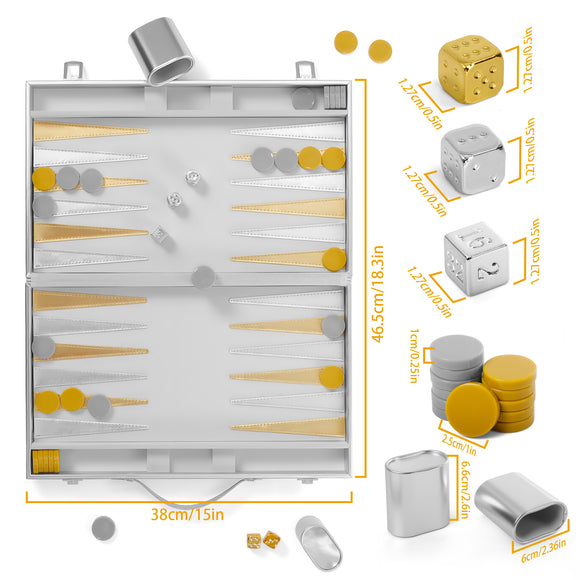
Premium Materials: Crafted with high-quality finishes, this backgammon board features a sleek surface, metallic dice, and silver dice cups for a luxurious touch that redefines the aesthetic of board games.
Complete Set: The set is turnkey ready for your first match, including stunning silver dice cups and weighted metallic dice, ensuring you have everything you need to start playing right away.
Elegant Gift: Beautifully packaged, making it an ideal gift for family, friends, or business partners — perfect for special occasions or collectors who appreciate the finer things in life.
Home Decor Statement: This is more than a game — it is a stylish addition to your living room, study, or game room that enhances any interior design theme.
Classic Entertainment: Enjoy strategic fun with family and friends, perfect for gatherings or leisurely evenings where conversation and competition flow freely.
Specifications:
• Closed: 38 × 23 × 5.5 cm (15 x 9 x 2 1/8 Inch)
• Open: 38 × 46.5 cm (15 x 18 1/2 Inch)
• Checkers: 2.8cm (1 1/8 Inch) Diameter
Bring sophistication to your play — the Story&Suns Luxury Backgammon Set turns every match into a refined experience.
9. Summary of Key Terms
| Term | Definition |
|---|---|
| Pip | The unit of movement on the board; typically corresponds to the number on the die. |
| Checker | The 15 playing pieces each player moves (also called stones or men). |
| Bar | The middle ridge separating the inner and outer boards; where hit checkers are placed. |
| Blot | A point occupied by a single checker, vulnerable to being hit. |
| Point | One of the 24 triangles on the board. |
| Prime | Several consecutive points occupied by two or more of your checkers. |
| Bear Off | The process of removing checkers from the board at the end of the game. |
| Gammon | Winning the game before the opponent has borne off any checkers (worth double points). |
| Backgammon | Winning while the opponent still has checkers in your home board or on the bar (worth triple points). |
10. Frequently Asked Questions (FAQs)
A: No. When playing backgammon for beginners, remember that checkers can only move forward toward your own home board. You cannot move backward, even if blocked.
A: If you roll numbers that correspond to blocked points and have no legal moves available, you forfeit that turn (or the part of the turn you cannot take). If you can play one number but not both, you must play the higher number.
A: Ideally, yes. However, if you roll a number higher than your furthest checker, you can bear off that checker. For example, if your furthest checker is on the 3-point and you roll a 6, you can remove the checker from the 3-point.
A: Not at all. The basic rules can be learned in 15 minutes. However, mastering the probabilities and strategy takes a lifetime, which is why the game remains popular.
11. References
- Magriel, P. (1976). Backgammon. Quadrangle/The New York Times Book Co. (Often referred to as the "Bible of Backgammon").
- United States Backgammon Federation. (2023). "Official Rules of Backgammon." usbgf.org
