

Backgammon is one of the oldest board games known to humanity, with a history stretching back nearly 5,000 years to ancient Mesopotamia. Despite its age, it remains a dynamic and thrilling game of strategy and luck. Whether you are a complete novice or looking to refresh your memory on the official rules, knowing how to set up backgammon with two players is the first critical step to mastering the game.

The beauty of backgammon lies in its blend of calculated risk and the roll of the dice. However, before the first die is cast, the board must be arranged with precision. An incorrect setup can lead to confusion and disrupt the flow of the game. In this comprehensive guide, we will walk you through the anatomy of the board, the exact placement of every checker, and the fundamental rules to get you playing in minutes. We will also highlight how a premium set, like the Story&Suns Gold Vegan Leather Backgammon Set, can transform your gaming experience.
- 1. The Anatomy of a Backgammon Board
- 2. The Official Starting Position
- 3. Step-by-Step Guide: How to Set Up Backgammon With Two Players
- 4. The Objective of the Game
- 5. Basic Movement Rules
- 6. Elevate Your Game: Luxury Backgammon Set Spotlight
- 7. Essential Strategy for Beginners
- 8. Quick Reference Setup Table
- 9. Frequently Asked Questions (FAQs)
- 10. References
1. The Anatomy of a Backgammon Board
Before you can set up backgammon with two players, you must understand the landscape of the battlefield. The backgammon board typically consists of a frame that opens flat to reveal two rectangular playing areas.
The Points
The board features 24 narrow triangles, known as "points." These triangles alternate in color (often dark and light, or gold and cream in luxury sets) to make counting easier. The points are grouped into four quadrants:
- Player's Home Board: The quadrant closest to the player on their right side.
- Player's Outer Board: The quadrant closest to the player on their left side.
- Opponent's Home Board: The quadrant opposite the player's home board.
- Opponent's Outer Board: The quadrant opposite the player's outer board.
The Bar
Separating the home boards from the outer boards is a ridge running down the center of the board. This is called "The Bar." This is where checkers are placed when they are "hit" by an opponent.
2. The Official Starting Position
The setup for backgammon is symmetrical but mirrored. Each player starts with 15 checkers of their own color. For the sake of this guide, we will refer to the players as "Player Gold" (Light) and "Player Silver" (Dark), inspired by our premium metallic dice sets.
The points are virtually numbered from 24 to 1 for each player. Point 24 is the furthest point away from you (in your opponent's home board), and Point 1 is the last point in your own home board. Your opponent numbers the board in the exact opposite direction.
3. Step-by-Step Guide: How to Set Up Backgammon With Two Players
Follow these steps to arrange the board correctly. Imagine you are the player sitting at the bottom of the board.
Step 1: The 24-Point (Opponent's Home Board)
Place two (2) of your checkers on your 24-point. This is the point furthest away from you, located in the far corner of your opponent's home board. Your opponent will place two of their checkers on their 24-point, which corresponds to your 1-point.
Step 2: The 13-Point (Midpoint)
Place five (5) of your checkers on your 13-point. This is the first point on the far left side of your opponent's outer board. These checkers are often referred to as "midpoint" checkers and are crucial for bringing reinforcements into your home board.
Step 3: The 8-Point (Your Outer Board)
Place three (3) of your checkers on your 8-point. This point is in your own outer board, three spaces away from the bar. These checkers serve as a defensive wall and a source of ammunition for attacking.
Step 4: The 6-Point (Your Home Board)
Place five (5) of your checkers on your 6-point. This is a critical defensive position within your home board. Securing this point early is often a key to victory.
Once you have completed these steps, your opponent should mirror your setup. If done correctly, no two opposing checkers will occupy the same point.
4. The Objective of the Game
The primary goal when you set up backgammon with two players is to move all of your checkers into your own home board and then "bear them off" (remove them from the board). The first player to bear off all 15 checkers wins the game.
Movement is always in a horseshoe shape. You move your checkers from your opponent's home board (24-point), through their outer board, across into your outer board, and finally into your home board (1-6 points). Your opponent moves in the exact opposite direction, meaning your armies will cross paths, creating opportunities for conflict and strategy.
Luxury Backgammon Set, Gold Backgammon Board Game
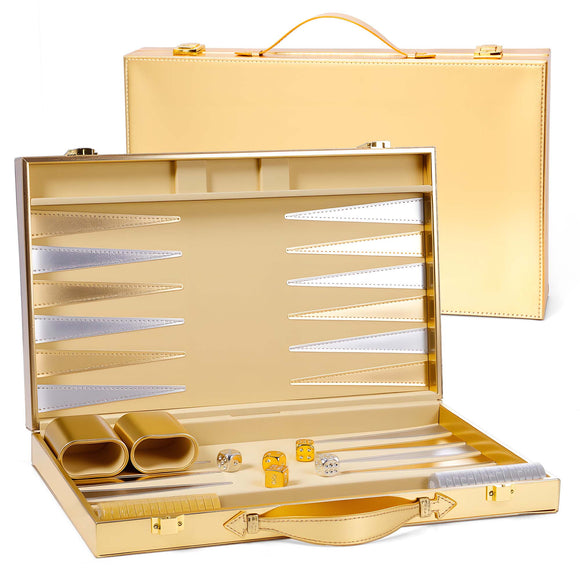
Why play on a standard board when you can elevate your game nights with the Story&Suns Gold Vegan Leather Backgammon Set? Crafted from premium gold-tone vegan leather and accented with gold-finished hardware, this luxurious board game combines timeless style with modern craftsmanship.
The set includes two dice cups in gold and silver finishes, along with matching gold and silver metallic dice, creating a refined contrast that enhances every play. Designed for both home décor display and travel-friendly entertainment, this backgammon set is a statement piece that blends functionality with sophistication.
Perfect for: Luxury gifts for game lovers, housewarmings, or special occasions.
Available Sizes:
- Large Size: Closed: 38 × 23 × 5.5 cm (15 x 9 x 2 1/8 Inch) | Open: 38 × 46.5 cm (15 x 18 1/2 Inch)
- Small Size: Closed: 28 × 19 × 5 cm (15 x 8 x 2 Inch) | Open: 28 × 38 cm (11 x 15 Inch)
5. Basic Movement Rules
Once the board is set, play begins with each player rolling one die. The player with the higher number moves first, using the numbers on both dice. If doubles are rolled, the players roll again.
- Open Points: A checker can only land on an "open point," which is a point occupied by two or more opposing checkers.
- Hitting: If a point is occupied by only one opposing checker (a "blot"), you can land on it. The opponent's checker is hit and sent to the Bar.
- Re-entering: A player with a checker on the Bar must re-enter it into the opponent's home board before moving any other checkers.
- Doubles: If you roll doubles (e.g., 4-4), you play the numbers four times.
7. Essential Strategy for Beginners
Now that you know how to set up backgammon with two players, here are three tips to improve your game immediately:
- Establish Points: Try to secure points (two or more checkers) in your home board. This creates a blockade that makes it difficult for your opponent to re-enter from the bar.
- Don't Leave Blots: Avoid leaving single checkers exposed unless necessary. A hit can set you back significantly in the race.
- Race vs. Contact: If you are ahead in the race (fewer pips to go), try to break contact and run for home. If you are behind, stay back and try to hit your opponent.
8. Quick Reference Setup Table
| Number of Checkers | Placement (Player Perspective) | Location Name |
|---|---|---|
| 2 Checkers | 24-Point | Opponent's Home Board |
| 5 Checkers | 13-Point | Opponent's Outer Board (Midpoint) |
| 3 Checkers | 8-Point | Player's Outer Board |
| 5 Checkers | 6-Point | Player's Home Board |
9. Frequently Asked Questions (FAQs)
Traditionally, the home board should be on the side nearest the light source. However, in casual play, players can decide which quadrant serves as the home board as long as they move in opposing directions.
The doubling cube is a marker used to raise the stakes of the game. It is not used for rolling. It tracks the current point value of the game. Players can propose a "double" during their turn before rolling.
Yes. If you roll the dice and no legal moves are possible (e.g., all landing points are blocked by the opponent), you lose your turn.
While dice introduce luck, backgammon is predominantly a game of skill. Over a long series of games, a skilled player will consistently defeat a novice despite the luck of the roll.
10. References
1. United States Backgammon Federation (USBGF). "Rules of Backgammon."
2. Magriel, Paul. Backgammon. 1976. (Often referred to as the bible of backgammon).
