
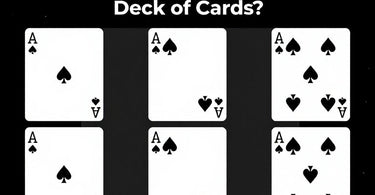
A standard 52-card deck contains 13 spades. They are one of the four suits, alongside hearts, diamonds, and clubs. Each suit has the same 13 ranks: Ace, 2 through 10, Jack, Queen, and King. If you are learning card games, teaching children to recognize suits, or checking a deck before game night, this is the simple count to remember: 13 spades in a standard deck, or 26 spades across two standard decks.

That answer is straightforward, but understanding how the 13 cards fit into the deck helps with more than memorizing a number. It makes card games easier to learn, improves counting and probability calculations, and helps you identify missing cards before you start playing. The distinction between a standard deck, a double-deck set, and specialty playing cards also matters when buying cards for a regular game night.
How Many Spades Are in a Standard Deck of Cards?
A standard deck of playing cards contains 13 spades. A traditional deck has 52 playing cards divided equally into four suits:
- 13 spades
- 13 hearts
- 13 diamonds
- 13 clubs
Each suit contains 13 cards, so the calculation is simple: 52 cards divided by four suits equals 13 cards per suit. The spade suit is one of the two black suits. Clubs are also black, while hearts and diamonds are red in a traditional deck.
There may also be two Jokers in the box, depending on the manufacturer. Jokers are not normally included in the standard 52-card count and do not belong to the spade suit. That means a deck containing 52 playing cards plus two Jokers has 54 physical cards, but it still has only 13 spades.
The number to remember
One standard deck = 52 playing cards = 4 suits × 13 cards. Therefore, there are 13 spades.
Does Every Deck Have Exactly 13 Spades?
Not every product sold as a deck of cards follows the standard 52-card format. Specialty decks may contain additional cards, fewer cards, alternate suit systems, or custom designs. Tarot decks, novelty decks, and some educational card sets are not standard poker decks.
For ordinary poker, bridge, rummy, and many family card games, however, the standard 52-card deck is the expected format. Unless the game instructions specify otherwise, assume there are 13 spades.
What Are Spades in a Deck of Cards?
Spades are one of the four traditional suits in a French-suited playing card deck. The suit is represented by a black symbol shaped like a stylized leaf, often described as an inverted heart with a narrow stem. Its name comes from the resemblance of the symbol to a spade-shaped digging tool or spearhead.
In a standard deck, the spade symbol appears on 13 cards. The suit includes numbered cards from 2 to 10, plus four face or special rank cards: Ace, Jack, Queen, and King.
Are Spades Black or Red?
Spades are black. The two black suits are spades and clubs. The two red suits are hearts and diamonds.
This color distinction is useful when sorting a deck quickly. If you separate all the black cards from the red cards, you should have 26 black cards and 26 red cards in a complete standard deck. Each color contains two suits with 13 cards each.
What Does the Spade Symbol Look Like?
The spade symbol is usually a solid black shape with a rounded, pointed top and a narrow stem at the bottom. It is visually distinct from the three other suit symbols:
- Spades: black, pointed leaf or spearhead shape.
- Clubs: black, three-lobed clover-like shape.
- Hearts: red heart shape.
- Diamonds: red diamond or rhombus shape.
Card manufacturers may use different artwork, line weights, and decorative treatments, but the suit identity remains the same. For learning and game play, the important feature is the recognizable suit symbol, not the exact illustration style.
What Are the 13 Spade Cards in a Deck?
The spade suit contains 13 ranks. In ascending order, they are usually listed as Ace, 2, 3, 4, 5, 6, 7, 8, 9, 10, Jack, Queen, and King. Some games treat the Ace as low, some treat it as high, and some allow it to function either way. The number of cards in the suit does not change.
| Card | Rank Type | Included in the 13 Spades? |
|---|---|---|
| Ace of Spades | Ace | Yes |
| 2 of Spades | Number card | Yes |
| 3 of Spades | Number card | Yes |
| 4 of Spades | Number card | Yes |
| 5 of Spades | Number card | Yes |
| 6 of Spades | Number card | Yes |
| 7 of Spades | Number card | Yes |
| 8 of Spades | Number card | Yes |
| 9 of Spades | Number card | Yes |
| 10 of Spades | Number card | Yes |
| Jack of Spades | Face card | Yes |
| Queen of Spades | Face card | Yes |
| King of Spades | Face card | Yes |
Is the Ace of Spades a Spade?
Yes. The Ace of Spades is one of the 13 cards in the spade suit. It is often visually prominent because many playing card manufacturers give it a larger or more elaborate central spade illustration. Some brands also print the manufacturer's name or decorative artwork on the Ace of Spades.
That special design does not make it an extra card. It is still one card within the 13-card spade suit. If you are checking a deck for completeness, count the Ace of Spades once.
How Many Number Cards and Face Cards Are in the Spade Suit?
There are nine numbered cards from 2 through 10, one Ace, and three face cards: Jack, Queen, and King. Some people refer to the Ace as a number card, but in standard deck descriptions it is usually listed separately from the numbered 2–10 cards.
For a quick inventory, remember this structure: nine numbered cards, three face cards, and one Ace. Together, they make 13 spades.
How Are the Four Suits Organized in a Deck?
A standard deck contains four suits, each with the same 13 ranks. The suits are not different in quantity: there are exactly as many spades as hearts, clubs, or diamonds. The difference is their symbol and color, not the number of cards.
| Suit | Color | Number of Cards | Typical Symbol |
|---|---|---|---|
| Spades | Black | 13 | Pointed leaf or spearhead |
| Hearts | Red | 13 | Heart |
| Diamonds | Red | 13 | Diamond shape |
| Clubs | Black | 13 | Three-lobed clover |
| Total | Two red, two black | 52 | Four suits |
Why Are There 13 Cards in Each Suit?
The 13-rank structure is part of the familiar French-suited deck used for many modern card games. Each suit repeats the same sequence of ranks, making the deck balanced and easy to use for games that depend on suits, ranks, or combinations of both.
For example, a player can hold a Queen of Spades and a Queen of Hearts. The rank is the same, but the suit differs. This consistent structure is what makes many card games possible without changing the basic deck.
How Many Spades Are in Two Decks of Cards?
Two complete standard decks contain 26 spades. Each deck has 13, so the calculation is 13 × 2 = 26.
This is useful when a game requires two decks, when you are preparing a larger group activity, or when checking a double-deck playing card set. A double-deck product normally contains 104 standard playing cards before Jokers or other additional cards are counted.
| Number of Standard Decks | Total Playing Cards | Total Spades |
|---|---|---|
| 1 deck | 52 | 13 |
| 2 decks | 104 | 26 |
| 3 decks | 156 | 39 |
| 4 decks | 208 | 52 |
| 5 decks | 260 | 65 |
Do Jokers Count as Spades in a Double-Deck Set?
No. Jokers are separate extra cards and do not belong to any of the four standard suits. A two-deck set may include four Jokers if each deck contains two, but the number of spades remains 26.
When buying a double-deck set, check whether the stated card count includes Jokers. This avoids confusion when a product description says 108 cards, for example: it may mean 104 standard cards plus four Jokers.
Why the Number of Spades Matters in Card Games
Knowing that there are 13 spades is useful in games where suit distribution, trick-taking, or card probability affects a player's decisions. It is not just a piece of trivia. It helps you understand what remains in the deck and how likely another player is to hold a particular suit.
Spades the Card Game
In the trick-taking game Spades, the spade suit is the trump suit. That means a spade can beat a card from another suit in a trick, subject to the game's rules. The 13 spades are distributed among the players at the beginning of a standard four-player game, with each player receiving 13 cards.
Players use their hands to estimate how many tricks they can win. Counting which spades have already been played can help estimate the remaining trump cards. Experienced players pay attention to the Ace and King of Spades, but they also track smaller spades because those cards can determine whether a player can safely win or lose a trick.
Poker
In poker, suits help form flushes and other combinations. A flush requires five cards of the same suit. Since a standard deck contains 13 spades, a player can make a spade flush if they receive five spades among their cards and the community cards, where applicable.
Knowing the total number of spades helps players understand the possible suit combinations, although poker decisions require more than simply counting cards. The cards already visible, the number of players, and the specific poker variant all affect the odds.
Bridge and Other Trick-Taking Games
In bridge, each player receives 13 cards from a 52-card deck. A player's spade holding can range from zero to 13, although most hands contain a mixture of suits. Suit distribution is central to bidding and play, which is why bridge players regularly think in terms of the 13 cards available in each suit.
For casual players, the practical lesson is simple: a complete deck always begins with 13 spades. Once cards are dealt or played, the number remaining in the deck or among other players changes.
Spades and Basic Card Probabilities
A standard deck has 13 spades out of 52 cards. That means the probability of drawing a spade from a thoroughly shuffled, complete deck is 13 out of 52, or 25%.
The calculation is:
Probability of drawing a spade
13 ÷ 52 = 0.25 = 25%
Each suit has the same chance of being drawn from a complete, properly shuffled deck. A spade is no more likely to appear than a heart, diamond, or club on a single draw.
What Is the Chance of Drawing the Ace of Spades?
There is one Ace of Spades in a standard deck. The chance of drawing it on a single draw from a complete deck is therefore 1 out of 52, or approximately 1.92%.
What Is the Chance of Drawing a Black Card?
There are 26 black cards in a standard deck: 13 spades and 13 clubs. The chance of drawing a black card on one draw is 26 out of 52, or 50%.
Does the Probability Change After a Card Is Drawn?
Yes. Once a card is removed, the deck has 51 cards left. If the card drawn was a spade, there are 12 spades remaining. If it was not a spade, all 13 spades remain. This is why card counting and probability calculations depend on which cards have already been revealed.
For beginners, the useful distinction is between an initial probability and a probability after information becomes available. The first draw from a full deck has a 25% chance of being a spade. The next draw depends on what happened on the first draw.
Common Mistakes When Counting Spades
1. Counting the Jokers as Part of the Four Suits
Jokers are normally not assigned to spades, hearts, diamonds, or clubs. A deck with 52 standard cards and two Jokers still contains 13 spades, not 14.
2. Thinking There Are More Spades Because the Ace Is Special
The Ace of Spades may have a larger illustration or decorative design, but it is still one card. It does not add another spade to the suit.
3. Confusing Black Cards With Spades
Spades are black, but not every black card is a spade. Clubs are also black. There are 26 black cards in total, split evenly between 13 spades and 13 clubs.
4. Assuming a Double-Deck Box Has Only 104 Cards
Two standard decks contain 104 playing cards, but the product may include extra Jokers or promotional cards. Read the packaging to distinguish the 104 standard cards from additional pieces.
5. Forgetting That Specialty Decks May Be Different
Novelty decks, educational cards, tarot decks, and custom game cards may not follow the standard four-suit structure. If you are playing a traditional card game, use a standard 52-card deck unless the rules say otherwise.
Choosing a Playing Card Deck: What Should You Look For?
If you are buying cards for regular use, the number of spades is rarely the main purchasing decision. Most standard decks have 13 spades. The more useful questions are how the cards feel, how clearly the suits are printed, whether the deck is easy to shuffle, and how it will be stored.
Choose a Standard 52-Card Deck for Most Games
For poker, bridge, rummy, and general family card games, choose a conventional 52-card deck with clearly printed suit symbols and ranks. This is the safest option when you want broad compatibility with familiar game rules.
Consider a Double-Deck Set for Frequent Game Nights
A double-deck set is useful when you want two coordinated decks available for different games, larger groups, or convenient replacement without buying another set separately. It also gives you 26 spades across both decks, which is the expected count if you are sorting or checking the complete pair.
Look at Card Readability and Handling
For regular play, clear indices and strong contrast matter more than elaborate artwork. Cards should be easy to identify across a table. A finish that allows comfortable shuffling and dealing is also worth considering, particularly if the deck will be used frequently.
Think About Storage and Presentation
If the cards will live on a coffee table, game-room shelf, or entertaining cabinet, presentation can matter as much as utility. A decorative storage box keeps the decks together and makes the set suitable for gifting. For a product that will be handled regularly, make sure the storage container is practical as well as attractive.
Comparison: Standard Deck vs. Double-Deck Set
| Feature | Single Standard Deck | Double-Deck Set |
|---|---|---|
| Standard playing cards | 52 | 104 |
| Number of spades | 13 | 26 |
| Typical use | Everyday card games and casual play | Game-night rotation, backup deck, or games requiring two decks |
| Storage | Usually a paper tuck box | May include a shared presentation box or separate compartments |
| Best for | Players who need one reliable deck | Hosts, collectors, and households that enjoy regular card games |
Pros and Cons: Buying a Decorative Double-Deck Playing Card Set
A decorative double-deck set is not necessary for someone who only needs inexpensive cards for occasional play. It becomes more worthwhile when you want the cards to be part of the presentation of a game night, a gift, or a thoughtfully styled tabletop.
| Pros | Cons |
|---|---|
|
|
Our recommendation is to choose a decorative double-deck set when you value both the playing experience and the object itself. If you only need cards for a quick game, a simple standard deck is the more economical purchase.
Story&Suns Palm Garden Double-Deck Playing Card Set
For customers who want a playing card set that feels considered enough to leave on display, the Palm Garden Double-Deck Playing Card Set from Story&Suns combines two custom decks with a decorative ceramic storage box. It is a practical choice for hosts and card players who want the set to contribute to the atmosphere of a coffee table, games cabinet, or entertaining space.

Palm Garden Double-Deck Playing Card Set
The set includes two coordinated decks: one botanical ivory deck and one deep navy deck. Both feature custom illustrated details, while the glossy tropical floral ceramic box has a removable lid and divided interior to keep the decks organized.
Why This Set Is Worth Considering
The strongest feature is the combination of useful storage and decorative presentation. The divided interior gives each deck its own compartment, so the cards are easier to keep together between games. The ceramic box is designed to remain visible rather than being hidden away in a drawer.
It includes two decks, which means 104 standard playing cards if both decks follow the standard 52-card format, plus any additional cards supplied with the decks. That would mean 26 spades across the two decks. Check the product packaging for the exact included card count and any extra cards.
The product is particularly suitable for:
- Hosts who enjoy keeping cards ready for guests.
- People who want a distinctive housewarming or entertaining gift.
- Card players who appreciate coordinated design and decorative storage.
- Homes where tabletop accessories are part of the interior styling.
It is less necessary if you only want the cheapest possible deck for occasional play. The value here is not a different number of spades or a special card-game advantage. It is the combination of two decks, original artwork, and a ceramic box that can function as a display piece.
For readers interested in other tabletop games and accessories, Story&Suns also offers a Luxury Silver Backgammon Set and a Heritage Burgundy American Mahjong Set.
Quick Summary: How Many Spades Are in a Deck of Cards?
| Question | Answer |
|---|---|
| How many spades are in a standard deck? | 13 |
| What color are spades? | Black |
| How many spades are in two decks? | 26 |
| How many cards are in the spade suit? | 13 ranks, from Ace through King |
| Is the Ace of Spades included? | Yes, it is one of the 13 spades |
| Are Jokers spades? | No, Jokers are separate extra cards |
| How many black cards are in a standard deck? | 26: 13 spades and 13 clubs |
| What is the chance of drawing a spade from a full deck? | 25% |
| How many spades are in a five-deck set? | 65 |
Frequently Asked Questions
How many spades are in a deck of cards?
There are 13 spades in a standard 52-card deck. The suit includes the Ace, numbered cards 2 through 10, Jack, Queen, and King.
Are there 13 or 14 spades in a deck?
There are 13 spades in a standard deck. The Ace of Spades is included in that count. It is not an additional fourteenth card.
How many black spades are in a deck?
All 13 spades in a traditional deck are black. There are also 13 black clubs, making 26 black cards in total.
How many spades are in a 52-card deck without Jokers?
There are 13 spades. Jokers are not part of the standard 52 playing cards and do not affect the number of cards in any suit.
How many spades are in a deck with two Jokers?
A deck containing 52 standard cards and two Jokers still has 13 spades. The two Jokers are extra cards and do not belong to a suit.
How many spades are in two decks of cards?
Two standard decks contain 26 spades in total. Each deck has 13 spades, so 13 multiplied by two equals 26.
What is the probability of drawing a spade?
The probability is 25% when drawing one card from a complete, properly shuffled 52-card deck. There are 13 spades among 52 cards, so 13 divided by 52 equals 0.25.
Is the Ace of Spades the highest card?
The Ace is treated as the highest card in some games and as the lowest in others. Its rank depends on the rules of the game being played, but it is always one of the 13 spades in a standard deck.
Are spades and clubs both black?
Yes. Spades and clubs are the two black suits in a traditional playing card deck. Hearts and diamonds are red.
References
The following sources provide background on standard playing-card composition, suit structure, and the rules of common card games.
- Encyclopaedia Britannica — Playing Card. Overview of the traditional playing-card deck and its suits.
- Pagat — Card Games and Playing-Card Rules. Reference resource covering card games, deck formats, and game conventions.
- Bicycle Cards — How to Play Spades. Playing-card manufacturer guide to the rules and structure of the Spades card game.
