

At Story & Suns, we operate as a design-driven gifts and home decor brand dedicated to the intersection of historical artistry and contemporary interior styling. We create and curate pieces with design, craftsmanship, and story at their heart, ensuring that every object feels personal in your home and meaningful when given as a gift. With years of experience serving sophisticated clientele in the US and European markets, we have developed a profound appreciation for the structural foundations of ceramic art.

Understanding the vocabulary of global ceramics requires a deep dive into historical silhouettes. Specifically, mastering your knowledge of Chinese porcelain vase shapes allows you to make informed decisions when curating your living space. These classical forms are not mere containers; they are architectural marvels refined over centuries of imperial patronage. From our experience, when collectors and interior designers understand the historical context and visual weight of Chinese porcelain vase shapes, they can dramatically elevate the sophistication of any room. In this authoritative guide, we detail the six most essential Chinese porcelain vase shapes, offering our expert perspective on how to integrate them seamlessly into modern, design-forward environments.
Table of Contents
- Summary Table of Chinese Porcelain Vase Shapes
- 1. The Meiping (Plum Vase)
- 2. The Guanyin Zun (Fishtail Vase)
- 3. The Pointed Neck Flat-Belly Vase
- 4. The Tianqiuping (Celestial Sphere Vase)
- 5. The Hulu (Double Gourd Vase)
- 6. The Cong (Square Tube Vase)
- Expert Sourcing and Quality Control at Story & Suns
- Frequently Asked Questions
- References
Summary Table of Chinese Porcelain Vase Shapes
To provide you with a quick reference guide, we have compiled a summary table of the core Chinese porcelain vase shapes discussed in this article. We recommend using this as a quick visual cheat sheet when planning your home decor arrangements or selecting luxury gifts.
| Vase Shape Name | Defining Structural Characteristics | Ideal Floral Pairing | Recommended Interior Style |
|---|---|---|---|
| Meiping (Plum Vase) | Narrow neck, broad expansive shoulder, tapering to a narrow base. | Single blossoming branches (like plum or cherry). | Minimalist, Transitional |
| Guanyin Zun (Fishtail) | Flared mouth, slender neck, swelling body, sweeping outward at the base. | Lush, cascading floral arrangements. | Contemporary Elegance, Eclectic |
| Pointed Neck Flat-Belly | Elongated narrow neck expanding into a flattened, wide spherical body. | Architectural stems or displayed empty as a sculptural object. | Modern Luxury, Art Deco |
| Tianqiuping (Celestial Sphere) | Large globular body resting on a flat base with a tall cylindrical neck. | Tall, heavy arrangements requiring counterweight. | Grand Traditional, Maximalist |
| Hulu (Double Gourd) | Pinched waist separating a smaller upper bulb and a larger lower bulb. | Trailing vines or delicate wildflowers. | Bohemian, Classic Asian-Inspired |
| Cong (Square Tube) | Square outer section with a cylindrical inner tube and circular foot/mouth. | Ikebana-style minimalist arrangements. | Ultra-Modern, Bauhaus |
1. The Meiping (Plum Vase)

Among the most iconic Chinese porcelain vase shapes is the Meiping, translating directly to Plum Vase. Originating during the Song Dynasty, the Meiping was initially designed as a functional vessel for storing wine. However, its elegant proportions soon elevated it to an ornamental status, specifically favored for displaying single branches of plum blossoms during the early spring.
Structurally, the Meiping is defined by a very narrow mouth and a short neck that abruptly expands into a broad, rounded shoulder. From this broad shoulder, the body tapers gracefully down to a narrow, flat base. The high center of gravity gives this shape an imposing yet refined presence. We recommend placing a Meiping vase on a console table or a prominent bookshelf where its sweeping silhouette can be appreciated without visual clutter. From our experience, these specific Chinese porcelain vase shapes command attention and work beautifully in transitional spaces that blend antique forms with modern textures.
2. The Guanyin Zun (Fishtail Vase)
The Guanyin Zun, widely recognized in Western design circles as the Fishtail vase, emerged prominently during the Qing Dynasty, particularly in the Kangxi period. The profile is spectacularly fluid: it begins with a flared mouth, dips into a slender neck, swells gently at the midsection, and then flares outward again at the foot, perfectly mimicking the elegant tail of a fish.
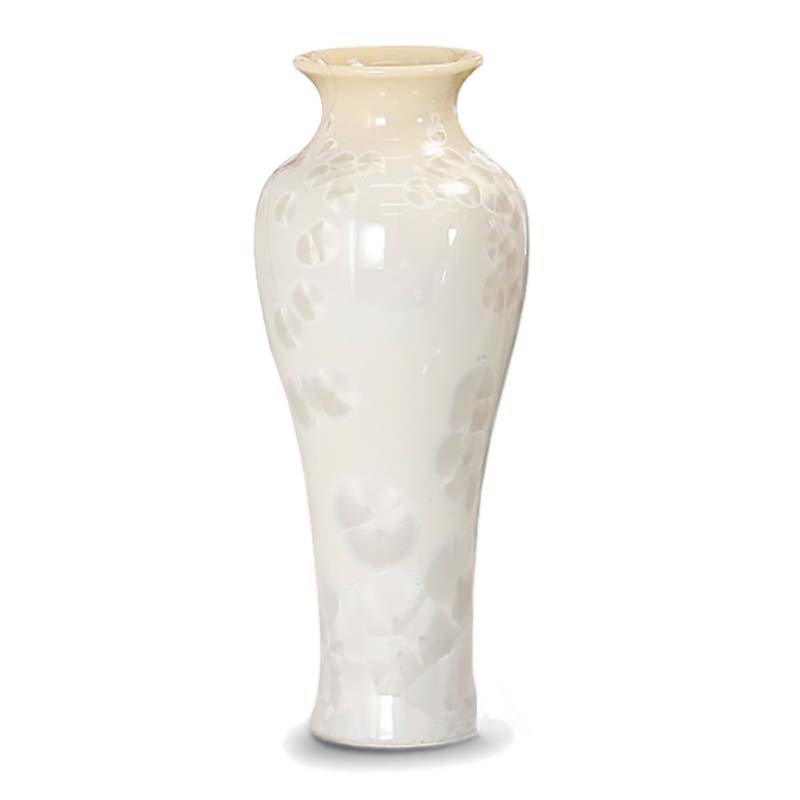
This is one of the most romantic Chinese porcelain vase shapes available, offering a dynamic sense of upward movement. We leverage this timeless silhouette within our own bespoke collection. We highly recommend the Story&Suns Crystalline Glaze Ceramic Fishtail Flower Vase. Designed to be both functional and profoundly decorative, this piece is handmade with an exquisite mother-of-pearl finish. From our experience, the crystalline glaze perfectly complements the sweeping fishtail curves, catching ambient light from every angle. You can display it solo as a statement piece or in curated sets to create a breathtaking focal point in a dining room or luxury foyer.
3. The Pointed Neck Flat-Belly Vase
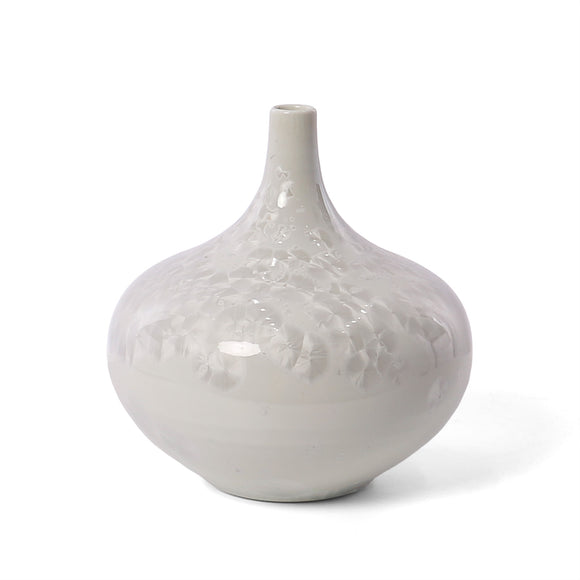
When cataloging the diversity of Chinese porcelain vase shapes, the pointed neck flat-belly configuration is a masterclass in contrasting proportions. This shape features a sharply tapered, elongated neck that abruptly meets a compressed, almost disc-like spherical body. The dramatic transition between the thin neck and the wide, flat belly creates a striking sculptural presence.
This shape demands exceptional craftsmanship to ensure the heavy, flat body does not collapse under its own weight during the kiln firing process. At Story & Suns, we celebrate this architectural triumph with our Handmade Jingdezhen Crystalline Pointed Neck Flat-Belly Vase. Manufactured in the historical porcelain capital of Jingdezhen, this unique ceramic art piece serves as the ultimate luxury gift and home display. We recommend utilizing this specific iteration of Chinese porcelain vase shapes in modern interiors, as its geometric tension pairs beautifully with mid-century modern furniture and stark, clean architectural lines.
4. The Tianqiuping (Celestial Sphere Vase)

The Tianqiuping, or Celestial Sphere vase, is one of the most substantial and visually arresting Chinese porcelain vase shapes. Originating in the early Ming Dynasty under the Yongle Emperor, this shape features a massive, perfectly globular body that rests directly on a flat base, topped with a tall, straight, cylindrical neck.
The naming of this shape is deeply philosophical; in ancient Chinese cosmology, the earth was viewed as square and the heavens as spherical. The massive round belly represents the celestial globe. Due to its significant visual weight and actual physical heft, the Tianqiuping is exceptionally stable. From our experience, this makes it the ideal candidate for dramatic, top-heavy floral arrangements that would easily tip over a more delicately balanced vessel. We recommend placing these grand Chinese porcelain vase shapes on sturdy center tables or directly on the floor in spacious, high-ceilinged entryways.
5. The Hulu (Double Gourd Vase)
The Hulu, or Double Gourd vase, is arguably the most auspicious of all Chinese porcelain vase shapes. Modelled directly after the organic shape of the bottle gourd vine, the vase features a smaller upper bulb resting seamlessly on top of a larger lower bulb, separated by a pinched waist.
In traditional Chinese culture, the double gourd is heavily associated with Daoism and represents longevity, fertility, and abundant blessings. Because the word Hulu sounds similar to the words for good fortune and wealth, these specific Chinese porcelain vase shapes are historically favored as premium gifts for weddings and milestone anniversaries. We recommend styling a double gourd vase in pairs on a mantelpiece. From our experience, the undulating curves of the Hulu shape introduce a soft, organic softness to rooms dominated by rigid, right-angled furniture.
6. The Cong (Square Tube Vase)
Perhaps the most architecturally severe of the Chinese porcelain vase shapes is the Cong vase. The design is a direct translation of ancient ritual jade objects dating back to the Neolithic Liangzhu culture. The Cong is defined by a square outer section that encloses a hollow, cylindrical inner tube, with a circular mouth and a circular foot extending slightly past the square body.
This fascinating juxtaposition of a circle within a square embodies the ancient philosophy of the round heaven and the square earth. When porcelain artisans revived this shape during the Song Dynasty, it became a staple of scholarly, understated elegance. From our experience curating contemporary spaces, the Cong is the most adaptable of all Chinese porcelain vase shapes for ultra-modern, minimalist apartments. We recommend leaving the Cong vase entirely unadorned by florals, allowing the sharp geometric angles and the quality of the ceramic glaze to speak entirely for themselves.
Expert Sourcing and Quality Control at Story & Suns
Identifying and acquiring authentic, beautifully crafted Chinese porcelain vase shapes requires rigorous oversight. At Story & Suns, we combine professional sourcing expertise, strict quality control, and selective in-house production. Working closely with independent designers, we ensure every item is both beautiful and structurally flawless.
Our years of experience in the demanding US and European markets have taught us that consumers are no longer satisfied with mass-produced decor. They seek objects with provenance and soul. When you purchase our Crystalline Glaze Ceramic Fishtail Flower Vase or our Handmade Jingdezhen Crystalline Pointed Neck Flat-Belly Vase, you are acquiring a piece of art that has passed through stringent inspection protocols. We highly recommend that when you invest in high-end Chinese porcelain vase shapes, you demand transparency regarding the origin, the glazing technique, and the firing process, ensuring the piece will endure as a treasured heirloom.
Frequently Asked Questions
Why are there so many different Chinese porcelain vase shapes?
The evolution of Chinese porcelain vase shapes spans thousands of years, driven by both functional necessity and philosophical symbolism. Early shapes were primarily utilitarian, meant for storing wine, oil, or water. Over time, imperial patronage and shifting aesthetic tastes allowed artisans to experiment, creating shapes that symbolized religious concepts, auspicious blessings, and sheer technical bravado.
How do I choose the right Chinese porcelain vase shapes for my home?
From our experience, you should consider the architectural lines of your room. If your space is highly modern and angular, incorporating soft, curved Chinese porcelain vase shapes like the Meiping or the Hulu can provide necessary visual relief. Conversely, if your room feels overly soft, the geometric rigidity of a Cong vase offers excellent contrast. We recommend selecting a shape that balances, rather than purely mimics, your existing decor.
Are these Chinese porcelain vase shapes meant to be used for flowers?
While many Chinese porcelain vase shapes, such as the Fishtail or Tianqiuping, are structurally ideal for holding water and heavy floral arrangements, they are equally respected as standalone sculptural objects. At Story & Suns, we believe that high-quality ceramics, especially those with complex crystalline glazes, require no botanical additions to justify their placement in a beautifully designed room.
References
- Pierson, Stacey. Chinese Ceramics: A Design History. Victoria and Albert Museum, 2009.
- Valenstein, Sheila. A Handbook of Chinese Ceramics. The Metropolitan Museum of Art, 1989.
- Fang, Lili. Chinese Ceramics. Cambridge University Press, 2011.
